Unmanned Surface Vehicle (USV) Models | Custom Scale Naval Vessel Replicas
Case Study: 1:50 Scale Hai Lei Li USV Model Production
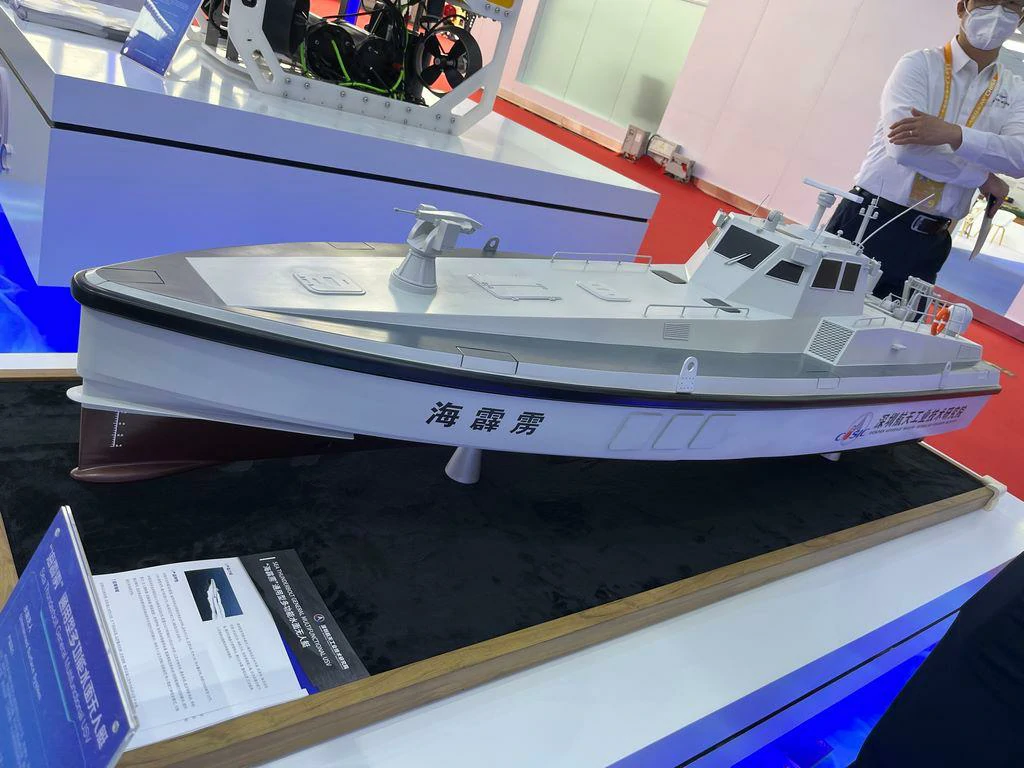
This case study details the production process of a scale model of the Hai Lei Li unmanned surface vessel (USV). The model was produced at a 1:50 scale, aiming for high fidelity with a target restoration rate exceeding 90%. The primary goal was to accurately replicate the streamlined hull, precise sensor layout, and intricate details of the original vessel while ensuring structural integrity. This was achieved using ABS + photopolymer resin composite materials. Below is a comprehensive breakdown of the entire production process, from material selection and 3D printing model manufacturing to post-processing.
1. Material Selection: Balancing Functionality and Detail
The model’s main body utilizes an ABS + photopolymer resin composite material, combining strength and precision:
-
ABS Structure: Used for large components such as hull shells, deck platforms, and superstructure frames, which require slight external forces (e.g., display placement or light contact). ABS offers excellent toughness and strong impact resistance, preventing breakage under its own weight or accidental collisions. Its surface can also be polished to a smooth finish, serving as a base for subsequent painting.
-
Photopolymer Resin Details: Applied to small or high-precision parts, such as radar arrays, optical sensors, communication antennas, railings, and cabin door handles. Photopolymer resin provides high molding accuracy (fine-layer texture), enabling the precise replication of complex curved surfaces (e.g., radar domes) and intricate details (e.g., 2mm-diameter screw holes). The surface exhibits a slight luster and can achieve an “industrial texture” without additional polishing.
2. Production Process: Modular and Precision Manufacturing
The production process was divided into four stages, emphasizing 3D printing model accuracy and scale model consistency:
-
Modular Disassembly and Data Preparation:
The original vessel was conceptually disassembled into six core components: hull shell, deck platform, superstructure, propulsion system, sensor group, and detail decorations. This modular approach allowed for optimized material allocation based on component functionality and material properties. -
3D Printing Execution:
- ABS Components: Printed using FDM technology (or photobased ABS resin) with a layer thickness of 0.2mm to balance accuracy and efficiency. Support structures were minimized via software optimization, and post-processing involved hot-air tool smoothing and 400-grit sandpaper polishing.
-
Photopolymer Components: DLP printing with 0.05mm layer thickness captured fine details. Parts were cleaned in specialized alcohol and cured under UV light for 20 minutes to enhance hardness. Transparent components (e.g., radar domes) underwent manual polishing to reduce haze and achieve a semi-transparent effect.
-
Component Refinement and Pre-Assembly:
Local deformations (e.g., ABS hull edges) were corrected using micro-files. Dimensional errors (e.g., >0.5mm) were addressed via AB glue adjustments or secondary printing. Key pre-assembly checks included hull-deck alignment, sensor positioning, and propeller-duct coaxiality.
3. Post-Processing: Achieving Industrial Fidelity
Post-processing transformed the raw 3D printing model into a high-fidelity scale model with realistic textures:
-
Primer Sealing and Base Coating:
A gray epoxy primer (or model-specific base coat) was applied to all components, sealing surface pores and providing a uniform substrate for painting. ABS parts required additional touch-ups to cover layer patterns and enhance surface roughness for better paint adhesion. -
Regional Color Grading:
- Hull: Graded from deep gray (bottom) to light gray (deck) using masking tape and multi-layered spraying with a pneumatic spray gun. Rust spots were added to the bottom for authenticity.
- Superstructure: Bases were lightly sanded to enhance paint adhesion, and details (e.g., windows, equipment) were painted with gradient techniques to simulate depth.
-
Sensors: Radar domes were partially masked and painted with semi-transparent gray to mimic the original’s translucent surface, while optical sensors featured silver metallic accents.
-
Texture Enhancement:
A matte clear coat was applied to unify colors and protect the surface. Frequent-use areas (e.g., railings) were lightly sanded with a matting agent to simulate wear and tear, further refining the scale model’s authenticity.
Final Output
The completed scale model integrates ABS + photopolymer resin components, achieving high 3D printing model accuracy and scale model fidelity. This case study demonstrates how modular production, precise 3D printing model techniques, and meticulous post-processing can deliver realistic industrial model replicas for naval applications.