Amusement Park Scale Model: Custom Entertainment Sand Table Models & 3D Printing Solutions
Creating detailed scale models is essential for visualizing and planning complex projects like amusement parks. This case study details the production of a custom sand table model, showcasing the process, materials, and techniques used to build a highly accurate representation of an entertainment venue.
Model Materials Selection for Amusement Parks
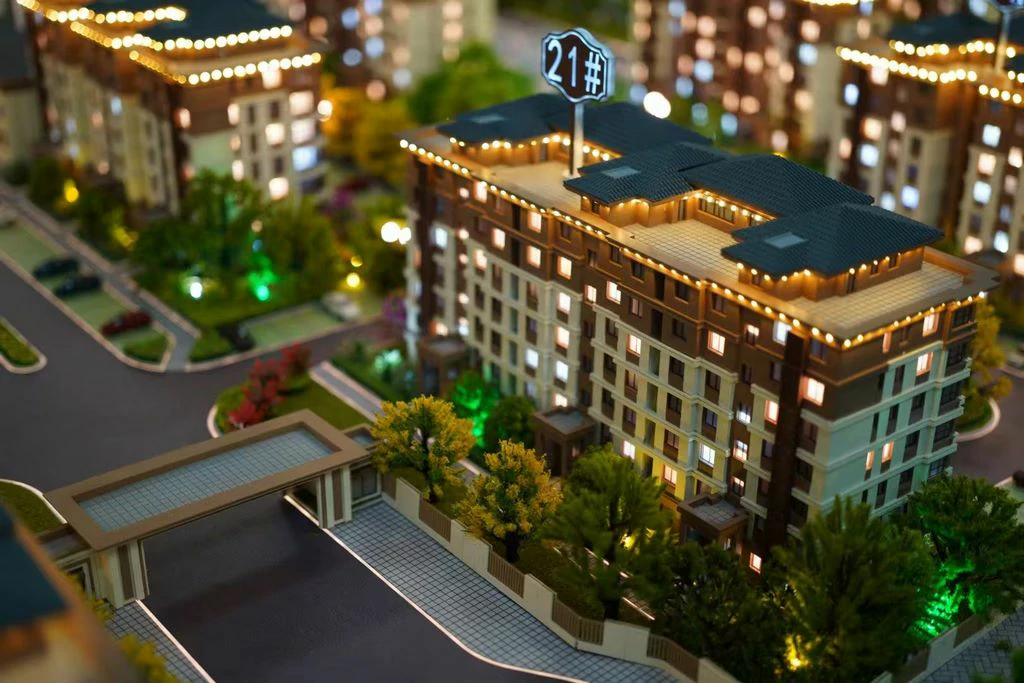
Building a durable and visually appealing sand table model requires careful material choice. The foundation incorporates a solid wood frame combined with PVC board as the bottom plate, offering both structural integrity and a clean aesthetic base. The main building structures are fabricated from ABS engineering plastic board, precisely cut via laser cutting for accuracy and detail. Amusement facility components (slides, climbing structures) utilize ABS boards reinforced with metal brackets, ensuring they meet necessary load-bearing requirements while maintaining their shape.
Road surfaces are recreated using PVC simulated pavement, capturing the texture of asphalt and cement. Water features are brought to life with LED light strips integrated beneath transparent resin, creating shimmering, animated effects when illuminated, especially effective at night. Vegetation includes meticulously chosen simulated lawns, shrubs, and trees, complemented by finer details like moss and grass elements. The overall model lighting system employs strategically placed LED point light sources and line light sources, allowing for targeted illumination and atmosphere creation on the scale model.
Production Process for Custom Sand Table Models
Constructing a sand table model involves precision steps to achieve the desired scale and detail.
- Base & Structure: The solid wood frame undergoes polishing and grinding before being clad with the PVC board bottom plate. Edges are secured using wood glue and clamps to guarantee a perfectly flat surface.
- Architecture & Facilities: ABS engineering plastic panels are laser-cut to size and assembled through splicing and precise bondo application. Amusement facilities are securely mounted using metal brackets, with gaps filled naturally using soil or appropriate filler materials.
- Roads & Water Bodies: PVC simulated pavement is cut to scale and adhered to the base, smoothed with sandpaper for a seamless finish. For water features, LED light strips are carefully laid down first, then meticulously covered with transparent resin to simulate realistic water ripples and reflections.
- Vegetation & Lighting: Simulated vegetation is planted according to the landscape design, with individual trees fixed using clay for stability and smaller shrubs adhered directly. The lighting system is integrated by wiring the LED lights back to a central power box, enabling zoned control for dynamic scene illumination.
Post-Processing and Coloring for Realism
Refining the sand table model enhances its visual appeal and realism.
- Surface Treatment: Building surfaces are smoothed by polishing with sandpaper. Gaps and seams are filled with soil or filler. A primer (such as white primer) is applied to improve the adhesion of the final model paint.
- Coloring Process: The “layered coating method” is employed for realistic coloration. Begin by spraying the base color (e.g., gray for building walls). Apply a middle layer (e.g., red for a roof) using a slightly different shade. Finally, apply the topcoat (e.g., white for stucco walls). A painter’s brush or thinner is used between layers to blend edges and prevent harsh color transitions.
- Detail Depiction: Architectural elements like doors and windows are protected with a covering liquid before fine-detail spraying or painting. Trim edges with a fine 000 grit pen. Vegetation is enhanced with a spray bottle to simulate dew or moisture. Tree bark texture is added using a marker pen. The integrated LED lighting is tested and adjusted for brightness and color temperature to ensure a harmonious night-time effect.
Quality Inspection and Delivery of Scale Models
Rigorous quality control ensures the finished sand table model meets high standards.
- Dimensional Inspection: Key elements like buildings, roads, and structures are measured against the 1:100 scale using a tape measure. Dimensional accuracy is strictly controlled.
- Functional Testing: The entire lighting system undergoes an electrical power-on test. The fixation of simulated vegetation and the smoothness of all surfaces are checked to ensure longevity and visitor experience in the model.
- Appearance Evaluation: The model is assessed visually under both natural light and simulated night lighting. Color transitions must appear natural, and all details should be clearly visible and well-executed.
Custom Entertainment Scale Models & Industrial Model Services
This case study demonstrates our expertise in creating high-quality scale model and sand table model services, particularly for complex entertainment environments like amusement parks. We also offer related services including 3D printing model support and general industrial model production, tailored to meet specific client requirements.
Need a custom sand table model or scale model for your project? Explore our range of model services, including custom entertainment scale models and more, on our website.