Commercial Complex Scale Models | Lighting Effects Display Models – Case Study: Production of a 1:100 Core Commercial Complex Sand Table Model
Project Overview
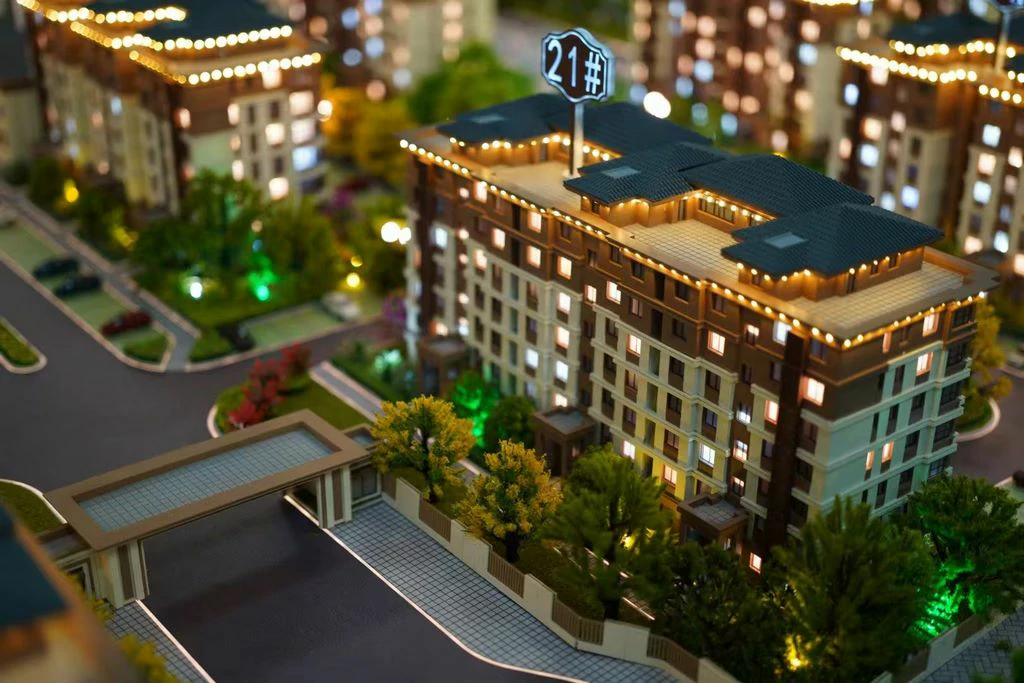
This case study details the production of a full-scale commercial complex model (1:100 scale), featuring over 90% detail restoration, for a prominent city landmark. The complex integrates vital components like a shopping center, office buildings, hotels, and leisure/entertainment facilities.
Utilizing a standardized factory process, the complete model production cycle from initial design to final delivery was accomplished within 45 days. The resulting 3D printed model and scale model effectively showcase the diverse functions and spatial characteristics of modern commercial complexes, serving as a high-fidelity sand table model.
Material Selection
Main Structural Material:
- PVC Foam Board: 5mm thick, chosen for its lightweight properties and plasticity, ideal for representing the clean lines of modern architecture in detailed industrial model production.
- Acrylic Sheet: Employed for glass curtain walls, offering high transparency, ease of cutting, and shaping to authentically replicate building facades.
- Wooden Frame: Acts as the primary supporting structure, ensuring the overall stability and durability of the complex scale model.
Decorative Materials:
- Metal Foil: Used to represent various facade decorative elements, adding textural detail.
- Special Resin Materials: Ideal for crafting intricate landscape ornaments and street furniture components.
- Environmentally Friendly Coatings: Applied for color expression, guaranteeing non-toxic, odorless, and sustainable finishing for display sand table models.
Manufacturing Process
Modular Production:
The complex was broken down into manageable modules (Shopping Center, Office Buildings, Hotels) using a “splitting first and then merging” strategy. Each module was further divided into floor units to ensure structural accuracy and efficient workflow for the scale model.
Precision Machining:
- CNC Engraving: Utilized for batch cutting of building components, achieving clean edges and precise dimensions necessary for architectural 3D printing model details.
- 3D Printing: Employed to manufacture complex decorative components and unique shapes that would be difficult or time-consuming to produce otherwise, enhancing the complexity of the industrial model.
- Laser Cutting: Applied for processing transparent elements like glass panes, ensuring precision and uniformity in materials like acrylic for the final scale model.
Detail Handling:
- Hand Carving: Used for intricate elements such as doors, windows, and railings, adding fine details often required for high-end sand table models.
- Sandwich Technique: Implemented to create layered building facades, enhancing the sense of depth and realism in the 3D printed model.
- Dynamic Components: Features like revolving doors and lighting systems were manufactured separately and embedded into the model structure for functionality in the finished industrial model.
Post-Processing and Color Expression
Surface Treatment:
- Joints were filled with professional putty and polished smooth for a seamless finish on the scale model.
- A matte primer spray was applied to enhance surface adhesion and prepare the model for painting.
- Special oxidation prevention treatment was applied to metal components to ensure longevity and appearance.
Color Expression:
- The main color scheme utilized light beige and light brown, common palette choices for commercial complexes in model representation.
- A layered spraying process (base color, shadow, highlight) was employed to achieve realistic depth and dimension on the 3D printing model.
- Dry sweeping techniques were used to enhance the texture expression of materials like stone and metal, crucial for authentic sand table model replication.
Landscape Production and Lighting:
- Realistic green landscapes were integrated using actual plant materials.
- Custom miniature figures and vehicles were added to scale, populating the model environment.
- The integrated lighting system employs LED patch light strips, effectively simulating the real-world night scene illumination commonly featured in scale model displays.