Construction Machinery Vehicle Scale Model Manufacturer
Case Study: Model Making of Construction Machinery Vehicle – Crane Model
1. Material Selection: Balancing Functionality and Realism
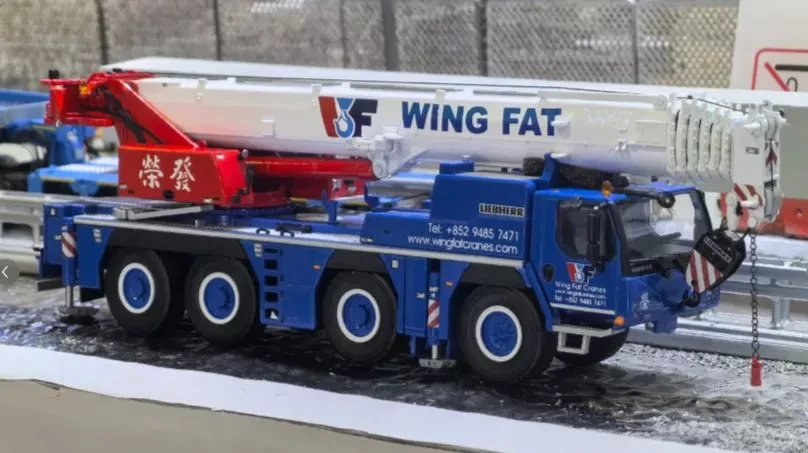
Before production, it is essential to analyze the structural features of the actual crane (e.g., the blue and white color scheme, red boom, identification text, etc.), and then select appropriate materials accordingly:
- Main Frame: Light foam board is used to construct the foundational structure, providing ease of cutting and shaping.
- Detail Components: Metal sheets (such as aluminum foil) simulate textured parts like lifting arms and counterweights.
- Decorative Materials: Stickers (including text, patterns, warning signs) are used to restore body text and visual elements.
- Base: A combination of foam board and light wood board offers a lightweight yet stable foundation.
2. Production Process: Step-by-Step Detail Shaping
1. Framework Construction
First, cut foam board to create the outlines of major components, such as the body, boom, and counterweight, then assemble them to form the crane’s basic shape. During assembly, compare real crane photos repeatedly to ensure proportional accuracy (e.g., body length, boom length, wheelbase).
2. Detail Shaping
- Metallic Texture Components: Cut metal sheets into the shapes of lifting arms and counterweights, then polish the edges for smoothness.
- Small Component Assembly: Create small parts like wheels, hooks, and warning signs, then glue them into place.
- Structural Reinforcement: Use glue and foam plates to reinforce key joints (e.g., boom and body connections) for stability.
3. Post-Processing: Coloring and Detail Enhancement
1. Spray Painting and Color Application
- Base Color Treatment: Spray the main body blue, the boom red, and the base light gray to mimic a real crane’s color scheme.
- Detail Layering: After the base coat dries, apply white paint to text areas and hand-draw details like WING FAT and Tel:+85 9485 7471** with black paint for clarity and precise positioning.
2. Detail Polishing
- Edge Treatment: Use sandpaper (from coarse to fine) to smooth the edges of components like the body and crane arm, eliminating cutting marks.
- Texture Enhancement: Apply silver metallic paint to metal parts (e.g., wheels, suspension arms) to simulate real metallic luster.
- Defect Correction: Touch up uneven spraying with white paint and complete identification details with black paint, achieving a restoration level close to 90%.
4. Finished Product Display: Achieving Realism and Aesthetics
The completed model closely resembles the actual crane in terms of body color matching, boom shape, and text/identification details. Through careful material selection, a step-by-step production process, and meticulous post-processing, the model achieves a restoration level of approximately 90%. This ensures both aesthetic appeal and high realism, making it suitable for use as a sand table model or industrial model.