Custom Scale Models for Clean Energy: A High-Fidelity Demonstration
Project Background
This case study showcases the development of a highly accurate scale model representing a new clean energy demonstration park. The model integrates key renewable energy components: a photovoltaic (PV) array, a wind turbine farm, and a smart microgrid system. Constructed as a sand table model, the project aimed for an accuracy exceeding 90%. Modular, layered manufacturing techniques were employed, allowing each subsystem (PV, wind, microgrid) to be displayed independently.
Core Production Processes
1. Terrain Base Construction
To establish the foundation, the terrain contours were meticulously reproduced using high-density polyurethane foam. CNC precision milling was employed to define the exact landscape features.
The surface was then finished with an eco-friendly gypsum mixture. This allowed for detailed manual shaping of road ruts and drainage ditches. Crucially, magnetic base interfaces were embedded throughout the terrain base for seamless transportation and easy disassembly.
2. Renewable Energy Equipment Reproduction
Photovoltaic Arrays
The PV panels were faithfully recreated using laser-cut acrylic panels. These panels feature a vacuum-coated surface for a realistic matte texture.
Wind Turbine Clusters
Wind turbine components utilized 3D printing model technology. 3D-printed resin blades with micro-bearings were designed for realistic, manual rotation. The tower cylinders themselves were crafted from etched stainless steel sheets.
Energy Storage Stations
Energy storage facilities were modeled using ABS injection-moulded housings. Embedded LED light strips provide visual representation, and transparent doors allow viewers to see the simulated battery module arrangements.
3. Power Transmission and Distribution System
The model’s electrical infrastructure was simulated using custom-made 0.3mm enameled wire to represent high-voltage cables. Utility poles along the transmission line were assembled using brass etched components.
Substation buildings were formed via thermoforming using PE sheets. Window frames incorporated laser-engraved film application technology for detail.
Innovative Material Applications
Photovoltaic Panel Matrix
Custom gradient grey acrylic panels were used for the PV matrix. These panels vary in reflection depending on simulated sunlight angles, enhancing realism.
Vegetation System
A sophisticated ground cover effect was achieved using electrostatic flocking combined with mineral pigments.
Dynamic Water Bodies
Epoxy resin layered casting techniques, along with embedded micro-mist generators, simulate the appearance of water vapour rising, creating a convincing dynamic water body effect.
Post-Processing System
1. Industrial-grade Coating Standards
To achieve durability and realism, the surfaces underwent rigorous post-processing.
- Wind Power Equipment: Components received a base coat of grey primer, followed by a sponge dipping method to apply a metallic oxide texture.
- Building Complex: Automotive-grade pearlescent paint was applied, combined with masking techniques to achieve a reflective facade effect.
- Surface Treatment: An oil paint staining process enhanced terrain shadows, with local dry brushing used to highlight wear and tear details.
2. Smart Interaction Enhancement
The model incorporates interactive elements to demonstrate functionality:
- Magnetic Control Switches: Hidden beneath the road surface, these switches trigger corresponding LED light strips to illuminate sequentially.
- Removable PV Assemblies: Photovoltaic panel assemblies are designed to be quickly removable via rear clips, enabling easy demonstration and replacement.
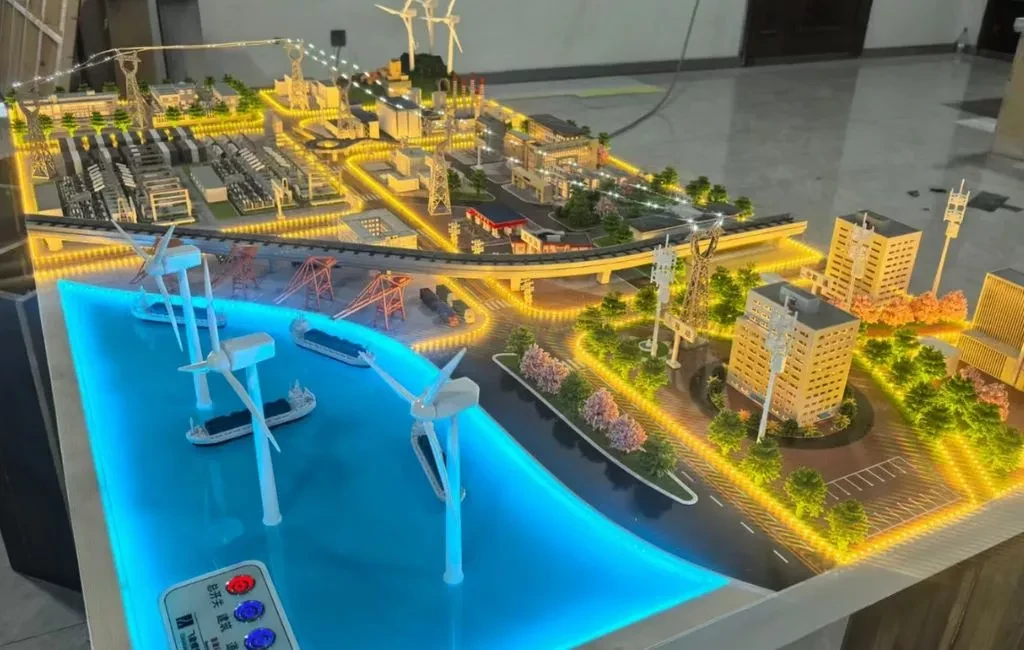
This case study involves a scale sand table model of a new energy demonstration park, encompassing a photovoltaicle array, wind turbine farm, and smart microgrid system, with a target accuracy of over 90%. A modular layered manufacturing process was employed to ensure that each system could be displayed independently.