in natural, professional English, optimized for SEO, while keeping all the original formatting and integrating the keywords naturally.
Custom Industrial Park Scale Model: Case Study in Exhibition Display Production
1. Preliminary Preparation: Drawing Study and Material Selection
Upon receiving the order for the architectural planning model of the industrial park, our team initiated a comprehensive process. This involved communicating closely with the client to confirm essential information, including building drawings, process flow requirements, and desired color schemes.
Material Selection Strategy for Industrial Style
Material choice was guided by two primary criteria: ease of processing and alignment with an industrial aesthetic. We prioritized materials like hard foam board (e.g., polystyrene) for the main structure due to its light weight and ease of cutting, enabling rapid shaping. For fine components, we specified metal pipes (stainless steel or aluminum alloy) to represent pipelines and supports, and acrylic sheets for transparent elements like factory glazing, offering clarity and ease of fabrication.
Ground and Greening Materials
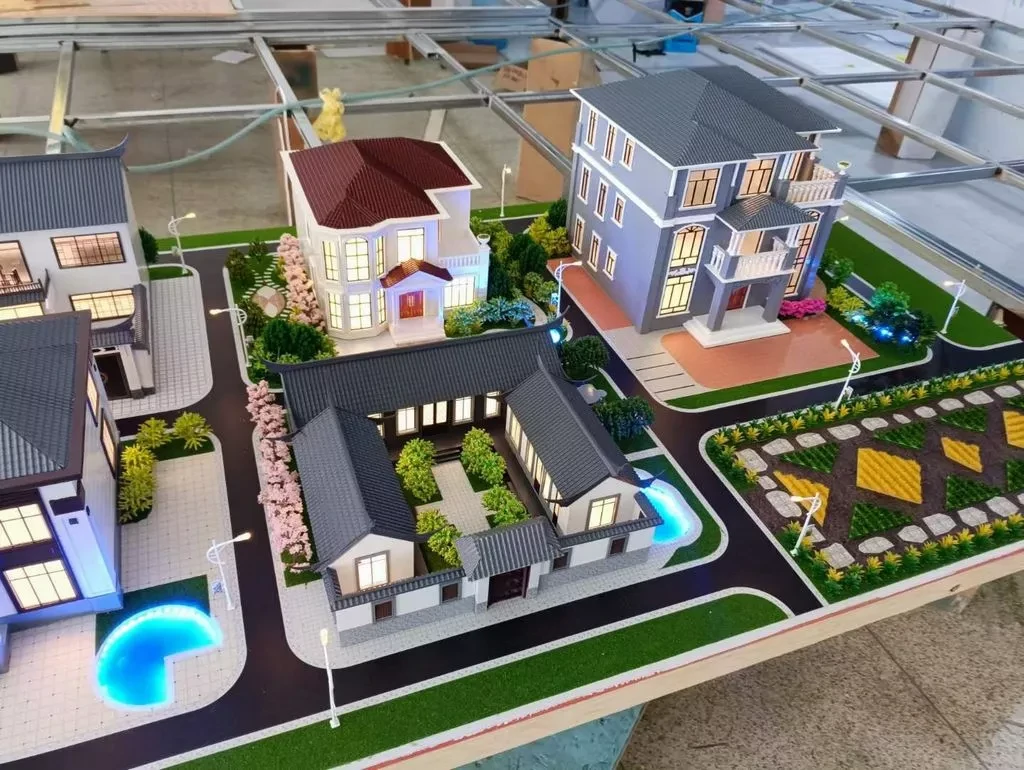
To accurately replicate the park environment, we used specific materials for groundscape elements. PVC boards formed the basis for roads and parking lots, while simulated lawns (artificial turf) were employed for green belts. The surrounding vegetation within the park was faithfully represented.
Lighting System Integration
Enhancing realism required a sophisticated lighting system. We implemented LED light strips to illuminate pipelines and equipment, simulating the operational lighting conditions within the facility. This approach ensures the model is dynamic and informative, even after dark.
2. Production Process: Layered Approach for Maximum Detail (The “90% Restoration” Goal)
The creation of the industrial park model adheres to a meticulous, step-by-step production process. This ensures a high level of accuracy and detail, striving for a “90% restoration” of the actual site. The process is divided into five key stages: Base Construction, Building Main Body Assembly, Pipeline and Equipment Integration, Groundscape and Greening, and finally, the Lighting System.
2.1 Base Construction: Establishing a Solid Foundation
- Foundation Stabilization: The base construction begins with assembling a sturdy wooden frame. This frame is then treated with moisture-proof paint and serves as the foundation upon which the tabletop is built.
- Top Layer Application: The tabletop itself is constructed using PVC boards. This layer is divided according to the actual park proportions (identifying areas like production zones, storage, and offices). Building locations are meticulously marked using a marker pen to ensure precise alignment during subsequent assembly. This forms the crucial foundation for a stable sand table model.
2.2 Building Main Body: Achieving Proportional Accuracy and Realism
This phase focuses on constructing the primary structures of the industrial park, emphasizing both proportionality and visual detail.
- Cutting and Shaping: Using the approved architectural drawings and specified scale, we carefully transfer the building outlines onto the foam board substrate. Precision cutting is achieved using a hot knife, ensuring clean edges far superior to manual methods.
- Layered Assembly Technique: To build structural complexity, the building is conceptually divided into three distinct layers: the foundation layer, the main building layer (factory or office structure), and the superstructure layer (e.g., tower cranes or chimneys). These layers are meticulously bonded together using environmentally friendly adhesives to guarantee structural integrity.
- Detail Restoration: Achieving realism involves refining the surfaces. Edges are smoothed using sandpaper to simulate sharp, finished building corners. Smaller architectural details, such as windows and doors, are cut from acrylic sheets and precisely installed to restore intricate features of the model.
2.3 Pipeline and Equipment Integration: Visualizing Process Flow
Accurately representing the internal workings of the industrial park is vital. This involves detailed modeling of both the infrastructure and specific equipment.
- Pipeline System: Metal pipes (stainless steel or aluminum alloy) are meticulously bent and bonded according to the drawings, simulating the material flow paths and conveying systems found in the actual park.
- Equipment Modeling: Key industrial equipment, such as reaction kettles and storage tanks, is fabricated using a combination of foam board and acrylic sheets. These components are scaled down accurately and positioned adjacent to their corresponding buildings.
- Dynamic Effects: To enhance realism, certain critical equipment (like pump rooms) incorporates small, subtle motors. This allows for the simulation of operational vibrations, adding a dynamic element to the static model.
2.4 Groundscape and Greening: Creating the Site Atmosphere
This stage brings the surrounding landscape of the industrial park to life, contributing significantly to the overall scene.
- Roads and Parking Lots: Roads are fabricated from durable PVC boards, with markings (like lane dividers or parking lines) applied using black acrylic paint. Parking lot areas are typically represented by gray foam board, simulating paved surfaces.
- Green Belt Simulation: Green spaces are created using simulated turf (artificial grass) within the designated areas. Additional realism is achieved by applying green acrylic paint to specific ground areas or using pre-fabricated green elements.
- Vegetation Detailing: Within green belt zones, small plastic shrubs and trees are strategically placed to mimic the scale and presence of real vegetation, enhancing the site’s visual authenticity.
2.5 Lighting System: Defining the Industrial Environment
Lighting is crucial for showcasing the model effectively, highlighting features and simulating operational conditions.
- Architectural Lighting: LED light strips are carefully routed along building contours and windows to simulate realistic nighttime illumination, defining the structure’s form.
- Pipeline and Equipment Lighting: Cold light strips are adhered along pipelines to simulate the lighting often used to inspect these systems during operation, adding depth and highlighting the infrastructure.
- Light Commissioning: After installation, the lighting system undergoes careful adjustment. Brightness and color temperature are fine-tuned to ensure the light and shadow effects accurately reflect the intended operational environment of the industrial site.
3. Post-Processing: Coloring and Detail Polishing for Final Polish
The raw model components require finishing touches to achieve a polished, professional appearance and complete the “90% restoration” goal.
3.1 Coloring Process
- Base Color Application: Using acrylic pigments, we apply the foundational colors to the building main body, floors, and equipment components. This ensures a consistent base color throughout the model.
- Detail Color Enhancement: Fine brushes are employed to meticulously add secondary colors and shading details to specific areas like windows, doors, and pipe connections, enhancing the model’s visual depth and fidelity to real structures.
- Material Texture Treatment: To restore the tactile feel of the industrial model, specific surface treatments are applied. Metal pipes receive a brushed silver metallic paint application. Acrylic factory glazing is often coated with a clear, protective film to simulate its real-world counterpart.
3.2 Detail Polishing and Scene Enhancement
- Defect Repair: Any visible imperfections, such as adhesive residue or seams, are carefully addressed. Adhesive marks are removed or blended using sandpaper, and gaps are filled to ensure a seamless, smooth surface.
- Scene Atmosphere Enhancement: To provide context and scale, the model environment is enriched with small accessories. This includes placing miniature truck models and worker figurines in appropriate locations around the buildings, simulating daily operations within the industrial park. Proper lighting adjustments are the final step to ensure the light and shadow effects perfectly match the operational conditions of the real facility.