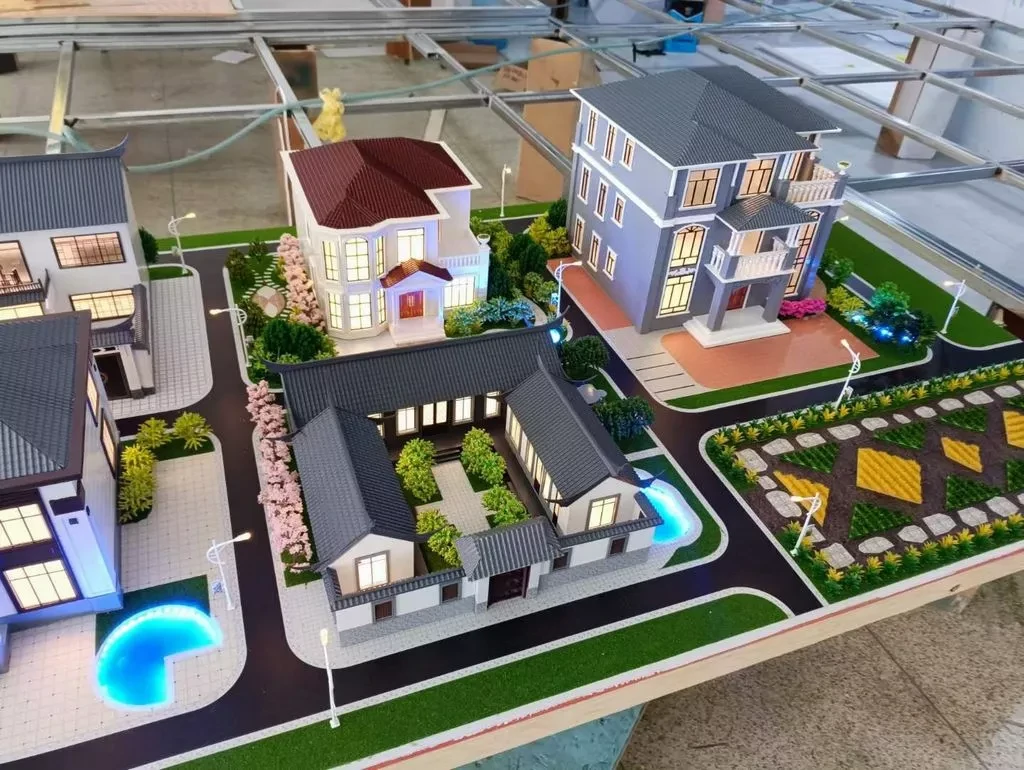
High Accuracy Custom Architectural Planning Models Production: From Architectural Drawings to Detailed Presentation Models
Explore our expert architectural model production process: transforming blueprints into highly accurate “factory level” presentation models (often referred to as scale models or sand table models).
Our specialized production workshop brings architectural visions to life through meticulous craftsmanship, material selection, and post-processing. This detailed walk through reveals the secrets behind achieving a “90% restoration” level of accuracy. Let’s delve into our production site.
1. Preliminary Preparation: Drawing Disassembly and Material Selection
Upon receiving the architectural drawings, we begin by confirming the architectural style and desired scale (e.g., 1:50) with the client or designer. The building design is then systematically disassembled conceptually into four primary components: main structure, landscape elements, roads, and walls.
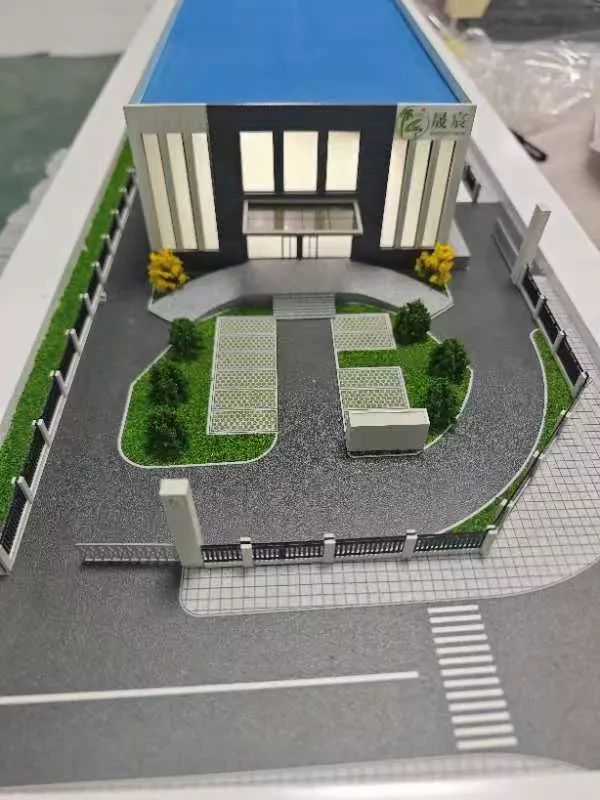
Material selection is crucial for achieving the required effect and durability. The main structure is typically fabricated from foam board (valued for its light weight and ease of cutting). Exterior walls utilize PVC board (selected for its ability to simulate metal or glass textures). Roads are crafted from grey sandpaper (to mimic the granular texture of asphalt). Black PVC board and metal strips are chosen for fences (authentically recreating dark fence elements). Green spaces feature simulated lawn turf, with white small stones meticulously laid into flower beds to restore specific decorative elements.
2. Main Structure: Cutting, Splicing, and Shaping
- Cutting and Splicing:
- The building’s outline is precisely cut from foam board using an art knife. Complex shapes, like an “L” main body, are carefully formed.
- PVC panels are cut into precise outer wall pieces and adhered to the foam structure using specialized glue. White PVC accurately simulates glass curtain walls, while black PVC faithfully reproduces building frames, enabling the restoration of the modern aesthetic often seen in architectural imagery, particularly emphasizing “black and white contrast”.
- Door and Window Details:
- Individual door and window units are constructed by first adhering transparent PVC sheets (simulating glass) and black PVC strips (simulating frames) to the foam substrate.
- Using a knife, intricate glass textures are then meticulously carved into the transparent PVC, ensuring the “light transmission” effect of the model doors and windows aligns perfectly with the reference image.
- Roof Shaping:
- The roof structure is fashioned from a foam board frame. Grey PVC board is applied to simulate a metal roof surface.
- The edges are reinforced with glue to guarantee the roof’s curvature and profile match the architectural drawings with utmost precision.
3. Landscape and Road Construction: Achieving Realism in Detail
- Roads and Walls:
- Road surfaces are created by covering foam board with grey sandpaper and securing it with glue.
- Fences are assembled by sandwiching black PVC board between metal bars. A simulated lawn surface is applied underneath to recreate the layered visual effect of “road + fence + greenery” seen in the reference photograph.
- Greening and Decorative Elements:
- Flower beds are detailed by laying white small stones on the surface and surrounding them with simulated lawn.
- Flower beds are further enhanced by inserting simulated flowers (yellow blooms to match the reference image) into the turf. A PVC board frame gives the flower bed a defined edge, ensuring the landscape elements possess the “exquisite detail” characteristic of high-quality architectural models.
4. Post-Processing: Coloring and Detail Polishing
- Coloring:
- Buildings are meticulously colored using acrylic paints. White PVC panels are coated with a light grey finish to simulate glass reflections, while black PVC panels receive a deep grey application to mimic metallic textures on exterior walls.
- Road surfaces, crafted from grey sandpaper, are brushed with a deep grey pigment to enhance the asphalt-like appearance. Metal strips on walls are similarly brushed with silver grey paint to restore and enhance their metallic luster.
- Detail Polishing:
- Sharp edges where foam board meets PVC board are carefully sanded using sandpaper, creating smoother transitions and a more natural, integrated surface.
- Fine brushes are employed to paint subtle “shadow lines” on doors and windows, significantly enhancing the building’s three-dimensionality and making it visually consistent with the source architectural image.
5. Finished Product Presentation: The “90% Restored” Factory-Produced Model
Once all components are assembled and meticulously finished, the resulting architectural model demonstrates a high degree of fidelity to the original drawings, typically achieving 90% restoration. This means the building outline, exterior wall materials, road textures, green space layout, and even minute details like “yellow flowers in flower beds” are exceptionally well-matched to the reference image.
This is the comprehensive process employed in our factory for producing custom architectural models (sand table models), 3D printing models, and industrial models. From careful material selection to precise process execution, every step is dedicated to maximizing the “restoration degree”, ensuring the final model serves as a solid, accurate presentation of the architectural design.