Scale Model Manufacturer: Expert Chemical Plant Production Case Study
1. Production Process and Flow Design
Structural Framework Construction:
Our process begins with meticulous scale model production. We utilize ABS plastic board as the foundational structure, employing laser cutting for precise construction of core elements like reaction towers and pipeline supports. For curved pipelines, we carefully soften and shape the material using a hot air gun to ensure smooth, streamline characteristics. The factory layout is developed at a 1:200 scale, meticulously adjusted based on satellite imagery to guarantee structural stability and accurate representation of the real-world environment.
Component Assembly:
- Reactor Vessels: Employing advanced 3D printing model techniques, we create nested hemispherical and cylindrical structures. Joints are carefully filled and polished using specialized compounds to achieve a seamless, flawless finish.
- Pipeline Network: Medical-grade silicone tubing is expertly dyed and secured. Brass valves, meticulously hand-forged, are strategically placed at critical junctions to enhance both realism and functionality.
- Ground System: A mixture of epoxy resin and mineral powder is poured to form the base. Dry sweeping techniques are then used to simulate realistic oil stains and rust marks, adding significant industrial model authenticity.
2. Advanced Materials & Techniques
Building Envelope:
We offer flexibility in materials for the exterior building walls. Options include etched acrylic boards or intricately crafted corrugated cardboard reliefs, both ensuring necessary structural integrity while conveying the substantial presence of industrial architecture.
Steel Frame Simulation:
To replicate the characteristic cold, rugged appearance of steel frames, we employ specialized treatments. These include copper wire electroplating or carefully spray-painted grilled bamboo sticks, achieving the desired visual effect for a realistic industrial model.
Glass Curtain Wall Solutions:
Our transparent PET film or UV-cured adhesive films provide the necessary clarity for glass surfaces, effectively minimizing unwanted reflections that could detract from the visual impact of the scale model.
Special Effect Components:
- Cooling Tower Steam: A unique solution involves soaking degreased cotton in glycerol solution to convincingly simulate rising steam plumes from cooling towers.
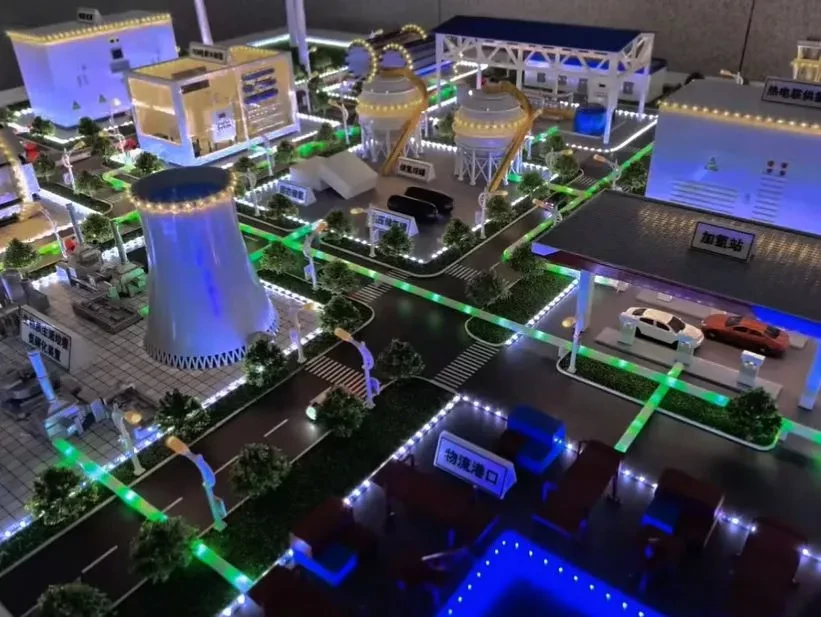
- Nighttime Illumination: We embed fiber optic bundles combined with cool LED light sources to create highly realistic nighttime lighting effects, enhancing the overall scene.
3. Post-Processing and Color Application
Base Preparation:
The entire model undergoes a base treatment process. After applying a uniform gray primer, specific areas are meticulously polished using 000 steel wool to accentuate realistic wear patterns. Welding seams are enhanced using a dry sweeping enamel paint technique, adding significant three-dimensionality and detail.
Color System & Aging Effects:
- Equipment Color Palette: The primary color scheme adheres to industrial standards, predominantly featuring industrial gray (70%), complemented by safety yellow (20%) and warning red (10%) to align with chemical plant safety regulations.
- Pipeline Color Coding: Pipelines are distinguished by color corresponding to fluid type: blue for water, green for chemical transport, and red for steam, improving clarity and visual communication.
- Rust Simulation: Applying specialized oil-painting pigments in multiple layers, coupled with the controlled salination method, generates natural-looking rust spots, significantly enhancing the model’s sense of age and industrial character.
Environmental Integration:
We integrate the model into its surrounding terrain and landscape. The chassis is constructed from gypsum to accurately shape the terrain features. Fine sand and gravel are carefully applied to simulate factory roads. Surrounding vegetation incorporates miniature moss and model trees, affixed using specialized atomized glue, creating a cohesive and natural overall presentation.
4. Restoration Control and Accuracy Verification
Ensuring Precision:
Accuracy is paramount in our scale model creation. We implement rigorous control measures:
- Component Ratio: Strict comparison between CAD drawings and high-resolution on-site imagery guarantees the precise dimensional accuracy of every part within the 3D printing model.
- Piping Layout: Adjustments are meticulously made according to detailed P&ID (Piping and Instrumentation Diagram) flowcharts to ensure logical and accurate pipeline routing.
- Color Fidelity: Our color application process is calibrated against the client’s enterprise VI (Visual Identity) standard color card to ensure perfect color reproduction.
- Interactive Elements: Key functional components, such as valves and instrument panels, are designed as movable structures, significantly enhancing the model’s realism and interactivity.