Cartoon Panda Model Production Case Study: Fiberglass Construction, Faithfully Reproducing the Adorable Appearance
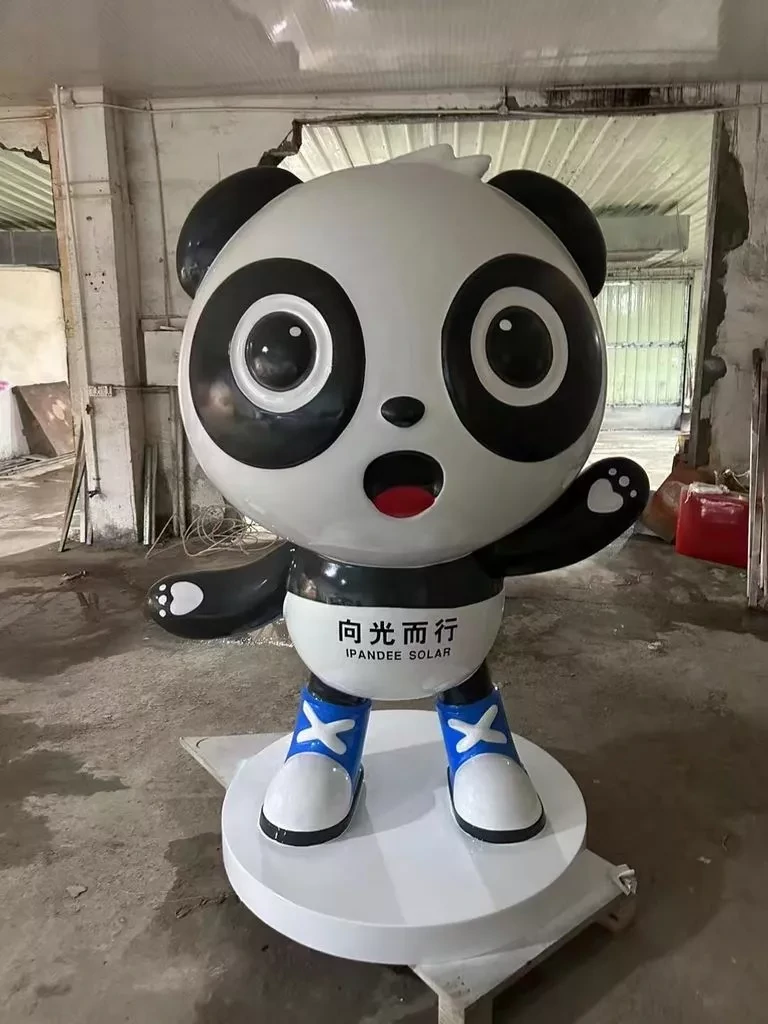
This case study details the production of a custom scale model (specifically a cartoon character model) – a life-sized, interactive cartoon panda model – for a children’s theme exhibition hall. The goal was to create a captivating central exhibit promoting panda culture using durable materials suitable for long-term indoor display. The client required a single-piece main body with a 90% accuracy benchmark.
I. Project Background
A children’s theme exhibition hall planned an interactive display area and commissioned the creation of a cartoon panda model as the central exhibit. The primary objectives were to attract children’s attention and effectively disseminate panda culture. The client explicitly requested a single-piece main body with a 90% accuracy benchmark, necessitating durable materials suitable for long-term indoor display.
II. Core Production Process
The creation of the cartoon panda model involved a meticulous process:
-
Precise Clay Sculpting: Professional sculptors initiated the detailed clay sculpting based on the client’s provided cartoon panda design concept drawings. Every morphological feature – from the round body proportions to the perpetually sleepy, adorable eyes and the slightly upturned mouth seemingly always holding a smile – was meticulously carved and underwent repeated refinement and adjustment to achieve the desired scale model accuracy.
-
Efficient Mould Replication: Upon perfecting the clay sculpture, the team proceeded to replicate the mould. High-quality silicone material was carefully applied over the sculpture to capture every intricate detail. Once fully cured, the mould was gently separated, yielding a complete and intricate mould – the foundation for subsequent production, crucial for ensuring the cartoon character model‘s high fidelity.
-
Precise Fibreglass Moulding: The next stage was fibreglass production. Craftsmen evenly applied prepared resin to the inner wall of the mould, layering with fine fibreglass cloth and pressing it firmly for optimal adhesion. Each layer, carefully cured to the ideal state, was added sequentially. This process, repeated layer by layer, gradually built the preliminary form of the panda model. Strict control over thickness and uniformity ensured the final scale model possessed excellent strength and stability.
III. Material Selection and Compatibility
-
Main Material: High-quality fibreglass was selected as the primary material for the cartoon panda model. This choice provided the necessary strength and durability to withstand daily interaction in an exhibition setting while offering sufficient plasticity to perfectly capture the panda’s rounded shape and delicate texture. Its smooth, lustrous surface complements the panda’s soft appearance, making it suitable for a scale model requiring aesthetic appeal alongside robustness.
-
Supporting Materials: For detailed finishing, eco-friendly paints and pigments were employed. These ensured vibrant, long-lasting colours crucial for accurately reproducing the panda’s classic black-and-white fur pattern and the natural hues of its face and ears. To enhance realism, soft rubber material was applied to the panda’s paw pads, simulating the texture of real paw pads, elevating the model beyond a standard scale model.
IV. Post-Processing and Colouring
-
Fine Sanding and Polishing: After the fibreglass components were formed and fully cured, meticulous surface finishing began. Craftsmen used fine sandpaper, progressing from coarse to fine grit, to smooth the surface, eliminating imperfections and achieving a porcelain-like texture. Professional polishing equipment and agents were then applied to enhance the surface gloss, making the cartoon character model appear exceptionally lifelike and meet the standards of a high-quality scale model.
-
Vivid Colouring Reproduction: The colouring process is a meticulous artistic endeavor. Craftsmen strictly adhered to the colour requirements from the design draft. A base colour was first applied to the entire model to establish the foundational tone. Using delicate brushes, they carefully detailed every aspect, including eye highlights and fur texture. The transition between black and white fur was handled using a gradient technique for natural, smooth colour blending, characteristic of a well-executed scale model.
Key Requirements Summary for the Cartoon Panda Model
- Single-piece main body
- 90% accuracy benchmark
- Durability for long-term indoor display
- Use of high-quality fibreglass as the primary structure
- Eco-friendly paints for colouring
- Realistic paw pad texture using rubber
- High-quality finishing (fine sanding, polishing) to achieve a smooth, glossy surface