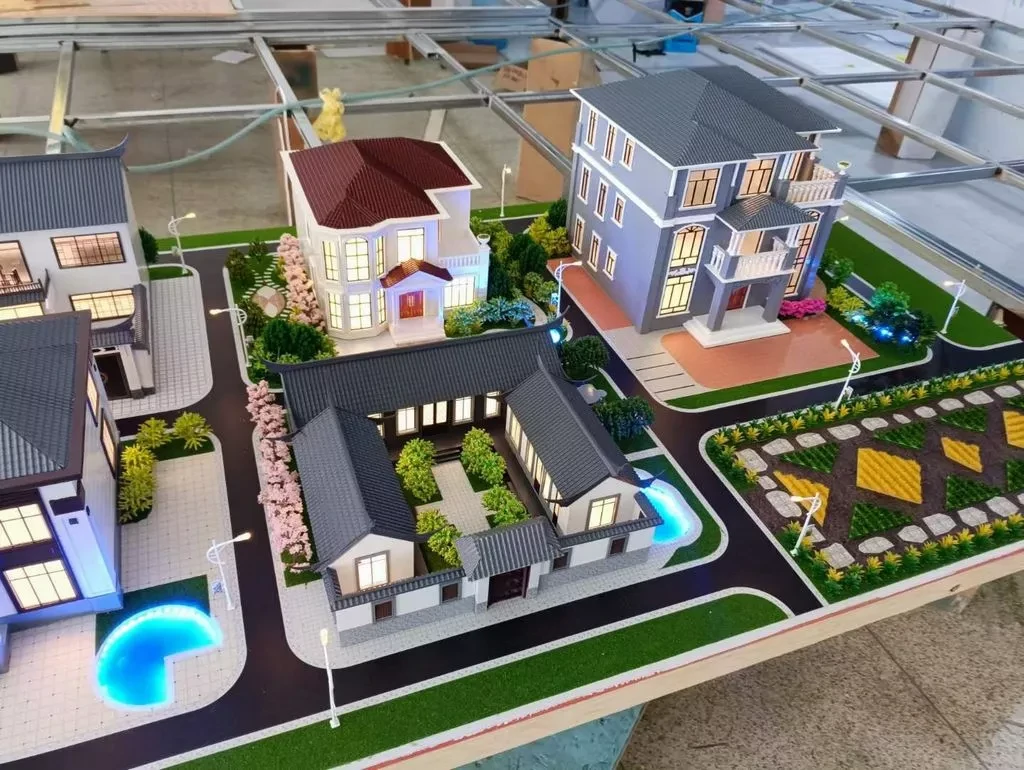
Case Study: Production of a Scale Model for Urban Commercial Center Exhibition
This project showcases a meticulously crafted scale model of an urban service complex, emphasizing modular construction, transparent façade design, and the functional representation of modern government and public service buildings. The model achieves a 90%+ accuracy in architectural form and spatial logic, serving as the primary visual medium for urban planning presentations, government publicity, and project reporting.
1. Material Selection
- Main Building: Constructed using ABS sheet and high-transparency acrylic composite material, balancing structural integrity with visual transparency.
- Exterior Components: The façade grille and window panes are fabricated from laser-cut ABS strips, replicating precise linear textures.
- Internal Modules: Utilizing 3D printing with photosensitive resin, internal functional components and equipment are accurately represented.
- Roads and Venues: Surface textures are simulated using wear-resistant PVC sheets and custom-designed ground stickers.
- Display Area: Incorporates micro LCD screens and light guide plates to simulate dynamic visual effects.
- Text and Labels: Employing UV printing technology, all text and identifiers are rendered with high clarity and durability.
2. Production Process
Base Construction
The foundation is built using high-density foam board, ensuring precise alignment of the building and surrounding road areas for overall proportionality and smoothness.
Architectural Shaping
- Structural Framework: ABS boards are cut and assembled to form the building’s core structure, with layered bonding to replicate cantilever designs.
- Façade Details: ABS laser-cut strips are meticulously applied to achieve uniform lines and spacing for the exterior grille.
- Transparent Atrium: High-transparency acrylic panels are cut and embedded to simulate glass curtain wall effects.
Internal Modules
- 3D-Printed Components: Functional units and equipment are 3D printed and precisely integrated based on zoning requirements.
- Display Integration: Micro LCD screens and light guide plates are embedded, with wiring interfaces reserved for interactive functionality.
Road and Detail Assembly
- Road Surfaces: PVC panels are laid with lane markings and boundaries, transitioning seamlessly at edges.
- Signage: Public service indicators and informational boards are affixed to enhance the model’s thematic relevance.
3. Post-Processing and Finishing
- Color Application: Using multi-layer spray techniques, the building’s main structure is treated with light gray and beige tones, while facade layering is enhanced through color-shifting sprays.
- Material Contrast: Exterior grilles are painted dark gray to contrast with lighter tones, highlighting their texture.
- Industrial Aesthetic: Internal modules adopt silver-gray and light-blue finishes, reflecting industrial textures and equipment details.
- Surface Protection: A matte protective coating is applied to all surfaces, ensuring durability while minimizing visual glare.
4. Detail Optimization and Final Presentation
- Proportional Adjustments: Joints and component positions are meticulously refined to ensure overall harmony.
- Visual Refinement: Surface impurities are removed, and dynamic effects are tested via screen activation, simulating real public service scenarios.
This scale model successfully integrates advanced materials and processes to deliver a 3D printing model-enhanced representation of the urban service complex. Its industrial model design and dynamic display capabilities cater to the demands of planning visualization, governmental outreach, and project documentation, earning client satisfaction for its precision and functionality.