Customization of Environmental Models, Equipment Models: Case Study – Industrial Waste Gas Treatment Equipment Scale Model
1. Defining Objectives and Design Strategy
The core objective of this project was to create a scale model for educational presentation and process visualization of industrial waste gas treatment equipment. The production team’s primary task was not merely to create a scaled-down replica, but to meticulously design and plan a model that accurately represents the essential steps of the waste gas treatment process.
This industrial model needed to extract key process elements – such as gas collection, pretreatment, core reactions, heat exchange, and final emissions – and transform them into understandable physical structures. The design strategy focused on achieving a balance: professional, precise, and aesthetically pleasing. The goal was to clearly display the equipment’s structural logic and guide the viewer’s understanding of the invisible “gas treatment” process through thoughtful use of color and lighting.
2. Core Structure and Material Selection
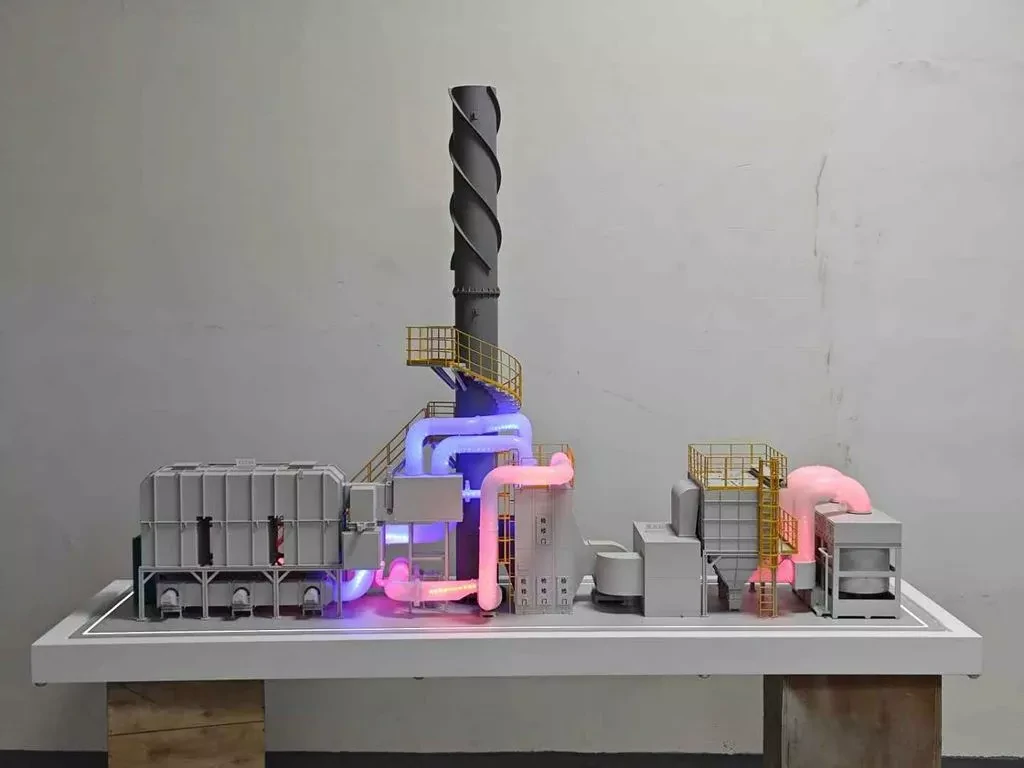
As shown in the image, the model’s main structure is clearly hierarchical. The production team employed lightweight, easily processable materials such as high-density foam board, acrylic board, and ABS plastic to construct the primary components.
- Main Building and Installation: The central gray multi-story building and the large rectangular processing device on the left form the model’s backbone. These components were likely assembled from precisely cut sheets using CNC machines, finished with polished surfaces, and painted in a gray matte finish commonly associated with industrial equipment. Achieving accurate proportions and a stable structure was paramount.
- Pipeline System and Color Coding: This is the “soul” of the entire model. The glowing blue and pink pipes visually represent the core process. During production, transparent or semi-transparent plastic tubes embedded with LED light strips were used. Blue light signifies cooled clean air or refrigerant pipelines, while pink light symbolizes hot air flow participating in chemical reactions. This sand table model utilizes intuitive color coding to clarify complex gas flows and states, significantly enhancing the model’s scale model‘s explanatory power.
3. Lighting Integration and Dynamic Presentation
The model’s success hinges significantly on its clever lighting design. While static models can only display structure, dynamic lighting demonstrates the “processes.” The production team integrated wiring into the model, embedding LED light strips within the pipes. Using a controller, they achieved sequential lighting or cyclic light flows, simulating the dynamic process of waste gas entering from the left, undergoing treatment, and finally being discharged from the top spiral chimney. This dynamic presentation allows the audience to visualize the entire “purification” process, leaving a strong impression.
4. Summary: Beyond Display – The Model’s Value
This environmentally friendly waste gas treatment equipment scale model is far more than just an exquisite exhibit. It serves as a powerful communication bridge, transforming complex technical concepts into an intuitive, visual language. Through rigorous structural design, innovative color and lighting applications, and meticulous detail, the production team effectively conveyed the core values of environmental protection technology – “purification” and “circulation” – to every audience member.
This industrial model is versatile, used not only in corporate exhibition halls and industry exhibitions but also as a vital teaching tool for environmental science education, sparking public interest and building trust in industrial environmental protection technology. This case study demonstrates that an exceptional industrial equipment scale model is a potent combination of technology, art, and communication, showcasing the powerful potential of industrial design and environmental concepts across all aspects.