3D Scale Car Model for Exhibition Display: Expert Glass Fiber Reinforced Plastic Production
Glass fiber reinforced plastic car model maker, specializing in high-fidelity scale model creation for exhibition displays. We deliver exceptional detail and durability for your automotive showcases.
I. Master Molding Process: Precise Replication of the Body Contour
Our process begins with meticulous scale model creation:
- Master Molding: Based on the actual vehicle, a precise 1:1 body master mold is sculpted. We focus on accurately reproducing the front end streamline, waistline curvature, and rear end features using high-density foam.
-
Surface Refinement: The mold surface undergoes repeated scraping and sanding with putty until it achieves an impeccable mirror-like finish. This ensures the final model has no dents or protrusions.
-
Mold Overlay Processing: A uniform layer of release agent is applied to the master mold. We then lay down glass fiber cloth and unsaturated polyester resin in multiple layers, followed by light sanding after each cure. After overall curing for 24 hours, the mold is disassembled and trimmed to form a bilaterally symmetrical exterior mold for the vehicle body.
II. Fiberglass Molding: Integral Casting and Detail Shaping
Once the mold is perfected, our scale model production enters the fiberglass molding phase:
-
Main Body Casting: Prepared resin and glass fiber are mixed and poured into the mold. Vacuum negative pressure technology is employed to eliminate bubbles, ensuring the material adheres closely to the mold’s inner surface. The casting cures for 8 hours before demolding, resulting in the rough body shell. Any surface imperfections, such as pinholes or cracks, are meticulously repaired with putty and polished smooth.
-
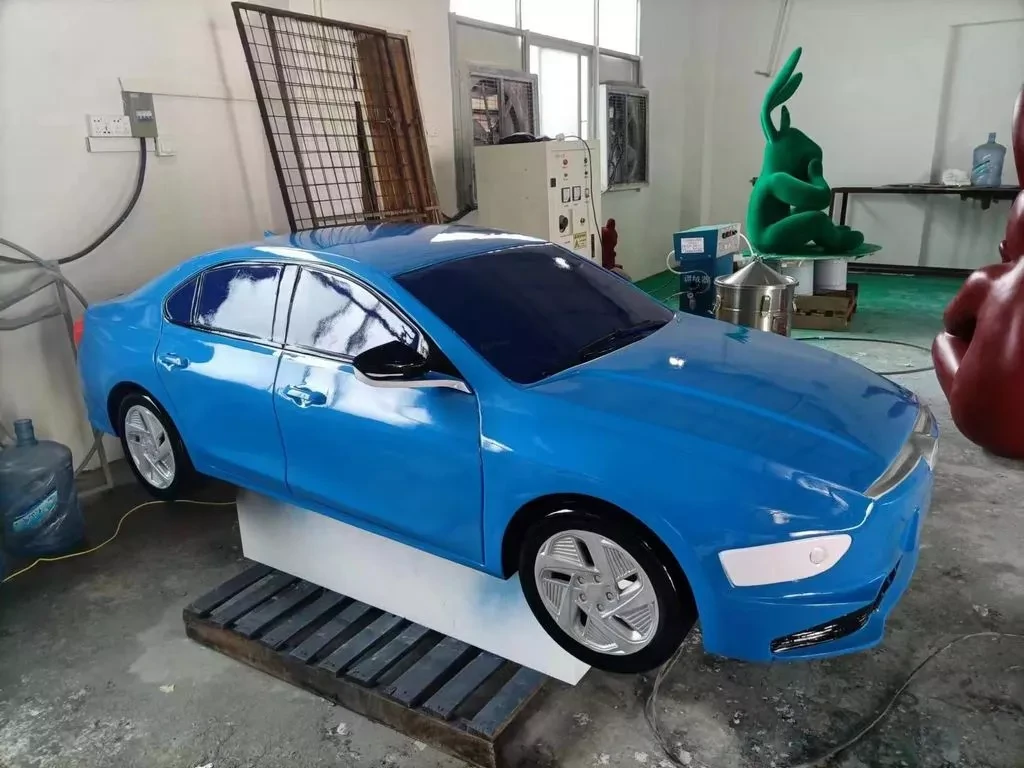
Component Separation System: Hinged components like car doors and engine hoods are individually molded, with precise hinge installation slots reserved at the edges. Window frames are hand-shaped using thin fiberglass strips and bonded to the main body with resin, ensuring a factory-fresh fit with gaps less than 0.5mm.
III. Surface Treatment: Achieving the Final Mirror-Like Finish
Attention to detail is paramount in scale model production:
-
Grinding Process: The body blank undergoes a rigorous grinding sequence: 80-grit sandpaper removes mold release marks, followed by 400-grit sanding of curved transitions, culminating in 1000-grit overall fine grinding until the surface is perfectly smooth and free of texture.
-
Paint and Varnish: A spray of epoxy primer seals the fiberglass surface. Fine putty is applied to level minor imperfections. For the topcoat, we utilize high-adhesion automotive-specific blue paint, applied in three thin coats (with a 30-minute interval between each). The final application of varnish dramatically increases glossiness, simulating the texture of real car paint.
IV. Detail Assembly: Metal Parts and Functional Simulation
The true character of the scale model emerges through meticulous assembly:
-
Wheel Hubs and Lights: Metal wheel hubs are precision-machined on a lathe and electroplated in silver before fitting with rubber tires. Custom red acrylic taillights feature embedded LED strips, connected via hidden wiring for realistic illumination.
-
Chrome-Plated Trim: A thin (0.3mm) metal strip, chrome-plated, is carefully pasted under the car door and along the window frame. Carefully heated with a heat gun, it conforms perfectly to the body’s curved surface, restoring the original vehicle’s metal decorative details.
Leveraging the high-strength properties of fiberglass material and expert handcrafted shaping techniques, our scale model achieves over 90% appearance replication while boasting excellent structural stability, making it ideal for long-term exhibition display.